
What to do after a break-in: securing your home and changing your locks
By Jacky Lee · Updated 2026-07-27

A break-in leaves more than physical damage. Even once the immediate danger has passed, there’s a specific kind of unease about the place you live no longer feeling as secure as it did. Getting the practical steps right, in the right order, helps you move past that faster.
Immediate priorities
If you’ve just discovered a break-in, safety comes first. Make sure no one is still in the flat, and if there’s any doubt, wait outside and call for help rather than checking room by room alone. Once it’s safe, file a police report, since you’ll likely need it for any insurance claim and it starts an official record of what happened.
Securing the home is the next step, and it doesn’t need to wait long. Most locksmiths can attend the same day for a break-in, and many treat it as a priority job given the circumstances. If the door won’t close properly or the lock is visibly damaged, ask about a temporary secure-up if a full repair can’t happen immediately.
Assessing what actually needs fixing
Not every break-in destroys the lock completely. Sometimes the damage is limited to the frame or strike plate, with the lock body itself still functional. Other times the cylinder is snapped or drilled, which usually means full replacement rather than repair.
| Type of damage | Typical approach |
|---|---|
| Lock still functions, minor frame or strike plate damage | Repair the frame, lock may not need replacing |
| Cylinder snapped, drilled, or forced | Full lock replacement, usually with an upgraded cylinder |
| Door itself no longer closes flush | May need a carpenter or contractor alongside the locksmith |
| No visible damage but entry method unclear | Locksmith can assess vulnerability and recommend next steps |
A locksmith can usually tell you within a few minutes of inspection which category you’re in, and whether the door itself needs attention beyond the lock.
Whether to upgrade, not just replace
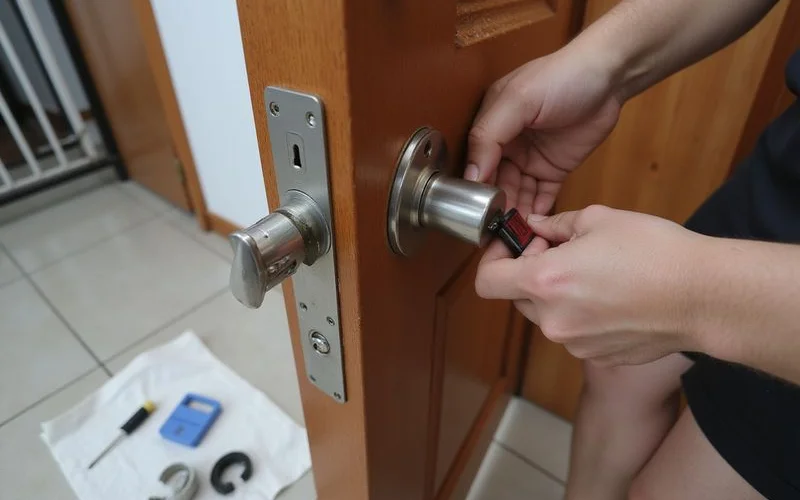
Since the original lock has already shown itself vulnerable, whether through its type, its condition, or simply its position, this is a natural point to consider an upgrade rather than putting back the same thing. A higher-security cylinder, an anti-pick or anti-drill rated lock, or additional reinforcement at the door frame are all common choices at this stage.
This isn’t about assuming every standard lock is unsafe. It’s about using the moment, since you’re already replacing hardware anyway, to close whatever gap the break-in exposed.
Documentation for insurance
Ask for an itemised invoice describing the damage and the repair or replacement carried out. Most insurers want this level of detail rather than a generic receipt, and having it ready speeds up your claim considerably. Photos of the damage before the repair, taken at the time you discover the break-in, are worth keeping alongside the invoice.
Talking to the technician on site
A locksmith who’s handled break-in repairs before should be comfortable walking you through exactly what happened to the lock mechanically instead of fixing it silently. Ask what they think the point of entry actually was, since this sometimes reveals a weakness you hadn’t considered, like a window latch that was already loose or a gate that wasn’t fully secured. No lock damage is one of the most consistently praised traits in locksmith reviews generally, but here the goal is the opposite: a clear, honest account of what was damaged and why, so you understand the fix rather than just paying for it.
Rebuilding a sense of security
Beyond the lock itself, some homeowners find it helps to review other access points at the same time: window latches, a gate that might also need attention, or whether a digital lock with activity logs would offer more peace of mind going forward. None of this is required, but addressing it together with the immediate repair means fewer separate callouts later.
Our residential locksmith category lists Singapore providers experienced with post break-in repairs and upgrades, scored through our ranking method on responsiveness and workmanship. Our homepage also covers broader home security topics if you want to look beyond the immediate repair.
Frequently asked questions
- Should I file a police report before or after calling a locksmith?
- File the report first if it's safe to do so, since you'll likely need it for insurance and any investigation. Securing the home doesn't have to wait long after, most locksmiths can attend the same day.
- Do I need to replace the whole lock or can it just be repaired?
- This depends on how the lock was damaged. If it's still structurally sound after a failed attempt, repair or rekeying may be enough. If it was forced, drilled, or broken to gain entry, replacement is usually the safer choice.
- Should I upgrade to a higher-security lock after a break-in?
- It's commonly recommended, since the original lock has already shown a vulnerability, whether that's its type, position, or condition. A higher-security cylinder or added reinforcement is a common upgrade at this point.
- Will my insurer need proof of the lock repair or replacement?
- Most insurers ask for an invoice or a report describing the damage and the repair carried out, so it's worth requesting a detailed receipt from the locksmith at the time of the job.
Related on this site
- Browse residential locksmith providers
- Moving into a new flat in Singapore: a locksmith checklist
- Who's responsible for changing locks when you move into a rental flat in Singapore
- HDB gate and door lock rules every Singapore flat owner should know
- Helping an elderly parent with a lockout or a home lock upgrade
- All guides →